
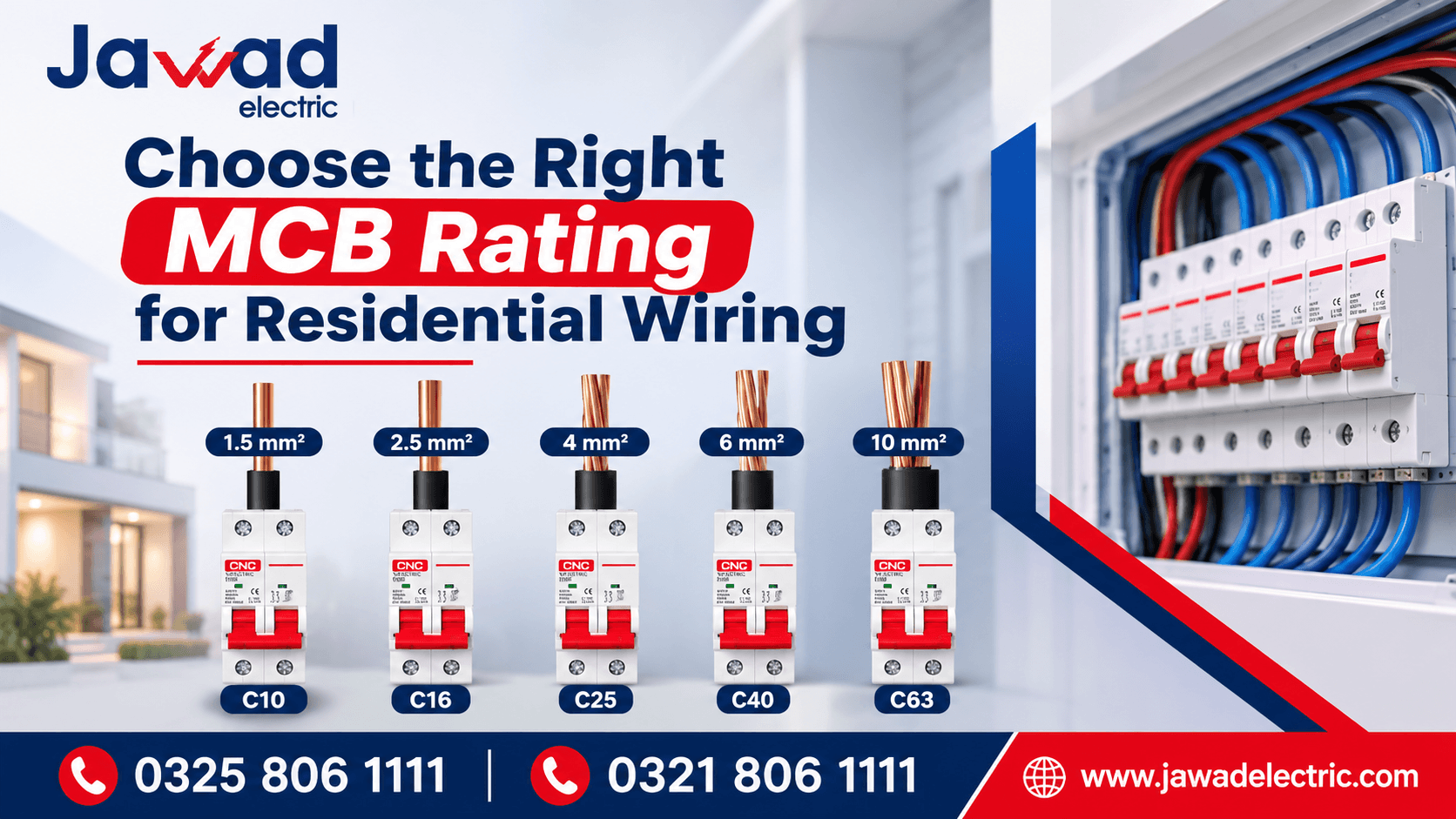
How to Choose the Right MCB Rating for Residential Wiring
Let’s be honest—messing with home electrical systems is the last thing anyone wants to do. But when it comes to setting up a distribution board, getting the Miniature Circuit Breaker (MCB) right is a big deal. Put simply, an MCB acts as your home’s silent bodyguard. It trips the second there’s an overload or short circuit, saving your expensive appliances from getting fried and your walls from catching fire.
The tricky part? Slapping in the wrong size MCB either results in your lights tripping every time you turn on the microwave, or worse—it won’t trip at all when a real hazard hits.
Here is a straightforward guide to choose MCB rating and nailing the right protection level for your home circuits without overcomplicating things.
Breaking Down MCB Ratings and Curves?
Before doing any math, let’s clear up what those cryptic letters and numbers stamped on the side of a breaker actually mean.
An MCB’s miniature circuit breaker current rating is measured in Amperes (A), showing how much current it can handle continuously. For houses, you’ll usually see ratings sitting between 6A and 63A.
Beyond just the amperage, manufacturers use letters (B, C, and D) to show trip curves:
- Type B: These trip fast (3 to 5 times the rated current). Use for basic lighting, fans and simple equipment where power surges are not a concern.
- Type C: They absorb some impact and end up breaking at 5-10 times the rated current. In cases where you have lots of heavy motor loads (such as ACs, fridges, washing machines which surge on their power up), reach for these.
- Type D: Trips at 10 to 20 times the rating. Honestly, you won’t need these at home; they are meant for heavy industrial machinery.
Consult a standard miniature circuit breaker rating chart when planning your distribution panel to quickly map load requirements to breaker curves.
Key Factors to Keep in Mind
Choosing a breaker is more than just selecting the matching breaker. Always have these golden rules on hand:
- Wire Gauge Comes First: Most DIYers make some kind of mistake at the Wire Gauge Comes First stage. The MCB serves to safeguard not the gadget in the wall but the copper wiring as well. Thin wires require a high amp breaker because the wire always melts inside the wall before the breaker will blow. Note that the size of the breaker should always be matched with the carrying capacity of the wire according to your miniature circuit breaker wiring diagram.
- Startup vs. Running Load: Motors & compressors consume significantly more juice when first starting to spin than while spinning. Include that initial burst in that number.
- Packed Distribution Boxes: Heat may trip distribution boxes if your distribution box is packed tightly, as heat is the main cause of distribution boxes tripping out early. A Hot Garage: Heat can trip distribution boxes if they are located in a hot garage or distribution box, as heat is the main thing that causes distribution boxes to trip out early.
Step‑by‑Step Calculation (Keep It Simple)
Want to figure out what size you need for a specific line? Here is the quick formula:
Step 1: Add Up the Watts
Tally the power draw of everything running on that line at once. For example, a living room line with a ceiling fan (75W), LED lights (50W), and a TV (150W) comes out to 275W.
Step 2: Do the Math (Ohm’s Law)
Step 2: Do the Math (Ohm’s Law)
Assuming a standard single-phase home supply of 230V:
Assuming a standard single-phase home supply of 230V:
Amps=Total WattsVolts\text{Amps} = \frac{\text{Total Watts}}{\text{Volts}}Amps=VoltsTotal Watts
For our living room example:
Current=275 W230 V≈1.19 A\text{Current} = \frac{275\text{ W}}{230\text{ V}} \approx 1.19\text{ A}Current=230 V275 W≈1.19 A
Step 3: Add a Safety Buffer
When installing an installed number, always multiply it by the safety factor of 1.25 to avoid nuisance random trips during voltage wobbles. Finally, when you have settled on a final amp rating, round it up to the nearest size which is commercially available such as 6A, 10A, 16A etc.
Common Traps to Avoid
- It certainly doesn’t make a light circuit safer to put a massive 32A circuit breaker on, it makes it useless as it won’t respond to any faults. Placing a massive 32A breaker on a light circuit makes it ineffective and unsafe to use.
- Don’t miss out the thickness of the wire: Always verify that size of wire you’re using: (e.g, 1.5 sq mm vs. 2.5 sq mm) before selecting the breaker.
FAQs
What size MCB is best for regular home lighting?
For standard lighting and fans wired with 1.5 sq mm copper cables, a 6A or 10A Type B MCB is the industry standard.
Can I use my whole house on one single main MCB?
Definitely not Divide your home into areas that include lighting, light plugs, heavy plugs (in kitchen), and air conditioning units and have them all in their own individual breakers.
What is the difference between RCCB and MCB?
An MCB protects against fire due to overload and helps conserve your wiring. The purpose of an RCCB (or RCD) is to interrupt power as soon as it occurs if the person getting the electric shock or current leaks to the ground contacts a person or object that conducts electricity and is grounded, thereby saving lives.

This Post Has 0 Comments